How Fitness Tech Startups in UAE Are Building Subscription-Based Workout Apps That Generate Recurring Revenue
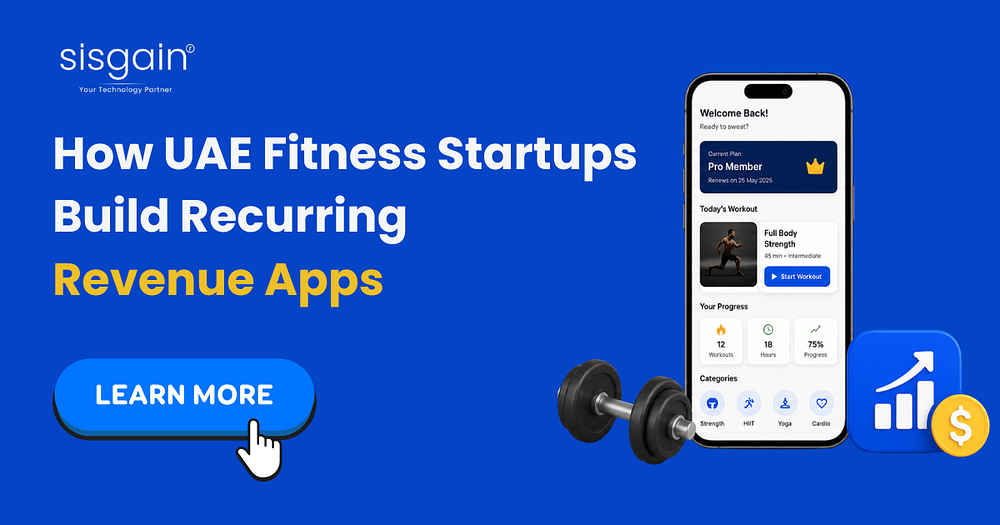
The UAE fitness industry is undergoing a major digital transformation. Consumers no longer want fitness access limited to a physical location or fixed class schedule. They want on-demand, personalized, and mobile-first workout experiences they can use at home, while traveling, or between meetings. That shift is pushing fitness brands across Dubai, Abu Dhabi, and the wider UAE to rethink how they deliver value.
Traditional gym-only models are evolving into hybrid fitness businesses that combine physical services with digital products. For startups, this creates a clear opportunity. Instead of relying only on memberships tied to a single facility, they can build subscription-based workout apps that generate predictable monthly income, strengthen customer loyalty, and scale beyond local geographic limits.
This model is especially attractive in a market like the UAE, where consumers are highly mobile, digitally connected, and increasingly focused on wellness. A well-designed app can serve new mothers looking for home workouts, executives wanting short training sessions, beginners who need guidance, and advanced users seeking premium coaching. That broad appeal makes digital subscriptions a powerful growth engine.
For modern businesses, subscription-based workout apps provide the ultimate solution: reliable, recurring revenue streams. Many fitness startups are now investing in Fitness App development in UAE to create scalable digital revenue models that grow month over month.
Why Subscription-Based Workout Apps Are Becoming the Future of Fitness Startups in UAE
Moving from physical gyms to comprehensive digital fitness ecosystems makes strong business sense. The most important advantage is revenue stability. Predictable monthly income helps founders plan hiring, content production, marketing spend, and product expansion with greater confidence. That matters in a competitive market where inconsistent cash flow can slow growth.
Consumer behavior is also changing fast. Users now expect convenience, flexibility, and personalization in nearly every digital service they use, and fitness is no exception. They want workout plans tailored to their goals, reminders that keep them engaged, and the ability to exercise on their own schedule. Subscription fitness apps answer those needs better than rigid, location-based models.
This shift is also making fitness businesses more attractive to investors. A gym with fixed capacity has natural growth limits. A digital fitness platform, on the other hand, can scale to thousands of users without adding a new physical branch every time demand increases. That scalability is one reason recurring revenue fitness startups are gaining attention across the UAE startup ecosystem.
The market backdrop is equally favorable. The UAE continues to invest heavily in health, wellness, sports innovation, and digital infrastructure. Consumers are more willing than ever to spend on products that improve performance, health outcomes, and convenience. As that demand grows, fitness tech startups in the UAE are finding that subscription models offer a smarter way to capture long-term customer value instead of one-time transactions.
The Business Model Behind Subscription-Based Workout Apps
Profitable subscription fitness apps rely on structured monetization strategies. The strongest apps do not depend on a single plan or audience segment. Instead, they build layered revenue models that allow them to serve casual users, committed members, and premium clients at the same time.
Monthly Subscription Revenue Model
The monthly subscription model remains the foundation for most digital fitness businesses. It is simple for users to understand and easy for startups to forecast.
- Basic Plans: Give users access to foundational workout libraries. These plans are ideal for price-sensitive users who want flexibility without advanced coaching.
- Premium Plans: Offer advanced analytics and specialized programs. These packages can include progress dashboards, customized plans, and exclusive content.
- Live Coaching Subscriptions: Provide real-time access to professional trainers. This creates a higher-value tier for users who want accountability and expert guidance.
- Annual Packages: Secure discounted yearly commitments to improve cash flow immediately.
A tiered structure works well because it lets startups widen their funnel. Entry-level plans attract more users, while premium tiers raise average revenue per customer.
Freemium + Upsell Strategy
Many successful apps grow faster when they reduce friction at the point of entry. That is where freemium models become useful.
- Free Workouts: Hook users with high-quality complimentary content.
- Premium Locked Content: Gate advanced routines behind a paywall.
- Add-on Services: Sell nutrition coaching and one-on-one virtual training sessions.
This model gives users a chance to experience the product before committing. If the free experience is valuable and well-designed, conversion to paid plans becomes more natural. In the UAE market, where users often compare multiple digital services before subscribing, this can be a strong acquisition strategy.
Hybrid Revenue Streams
The most resilient recurring revenue fitness startups often expand beyond subscriptions alone.
- Subscription + eCommerce: Sell fitness gear directly through the app.
- Supplements: Integrate nutritional product sales.
- Trainer Booking: Create a marketplace for booking in-person or premium virtual sessions.
- Corporate Wellness Packages: Offer B2B subscriptions for UAE companies.
This hybrid model increases lifetime value and reduces dependence on a single income source. For example, a user paying for monthly access may also buy branded resistance bands, sign up for a nutrition plan, or join a paid challenge. Over time, that creates a stronger and more diversified business.
Core Features Fitness Tech Startups Are Building Into Subscription Workout Apps
To keep users paying month after month, apps need robust features. A beautiful interface alone is not enough. The product must solve real user problems, deliver visible progress, and create reasons to come back regularly.
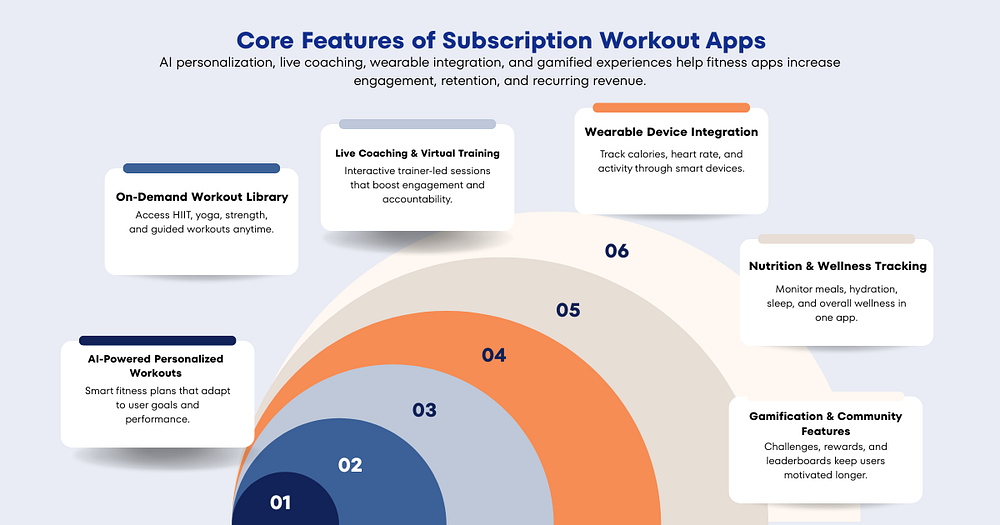
Personalized Workout Plans
AI-based fitness recommendations guide users toward their goals, whether that means weight loss, muscle gain, mobility, or post-injury recovery. Adaptive workout programs scale automatically with user progress, making the app feel responsive rather than static. Personalization is especially important because users are more likely to stay subscribed when the content feels relevant to their current level and goals.
Video-On-Demand Workout Libraries
Categorize workouts by style, such as HIIT, yoga, strength, Pilates, or functional training. Build progressive difficulty levels from beginner to advanced, and include offline access capabilities so users can train anywhere. A strong content library increases perceived value and gives users more reasons to remain subscribed over time.
Live Coaching and Virtual Training
Real-time trainer broadcasting brings the studio experience home. Add interactive group classes and premium private coaching features to increase engagement. These features also help simulate the accountability of in-person training, which is often missing from self-guided fitness products.
Wearable Device Integration
Sync with popular hardware like Apple Watch, Fitbit, and Garmin. Real-time heart rate tracking and calorie burn syncing keep users motivated and help create a more data-driven experience. Users increasingly expect health apps to connect with the devices they already use.
Nutrition and Wellness Tracking
Provide customized meal plans. Integrated calorie, macro tracking, hydration monitoring, sleep insights, and wellness check-ins give users a more complete health dashboard. This broadens the app from a workout tool into a lifestyle platform.
Gamification and Community Features
Launch monthly fitness challenges and community leaderboards. Fitness streaks, badges, milestone celebrations, and referral reward programs build stronger user loyalty. Community creates social motivation, and social motivation supports retention.
Technology Stack Behind Subscription-Based Fitness Apps
Building a premium app requires the right underlying technology. Fitness entrepreneurs often focus first on visible features, but the real success of a subscription product depends just as much on the architecture behind it.
Mobile App Frontend Technologies
You must weigh cross-platform frameworks against native development. Cross-platform options can reduce development time and cost, while native builds may offer deeper optimization for device-specific performance. High performance ensures smooth video playback and responsive interfaces, while prioritizing intuitive navigation guarantees a great user experience. Many startups choose App development for IOS and Android to launch faster and maximize their market reach.
Backend Infrastructure for Scalable Subscription Apps
Cloud backend architecture and secure user authentication form your core systems. Automated payment subscriptions, seamless video delivery, content management, and user retention tracking handle monetization and analytics. A subscription product must also support high uptime, secure payment processing, role-based admin controls, and strong data protection. Scalable subscription apps require robust software application development in the UAE to handle rapid growth, data security, and recurring billing.
AI and Personalization Engines
Smart workout recommendations analyze past activity to suggest the next class. User behavior tracking identifies drop-off points, while churn prediction algorithms and smart push notification reminders keep users active. AI can also help personalize class recommendations, schedule nudges based on user habits, and tailor messages to users who are at risk of canceling.
Why User Retention Is the Biggest Challenge for Subscription Fitness Apps
Understanding why users cancel subscriptions is vital. Getting app downloads is one thing. Keeping users engaged for six months, a year, or longer is where real business value is created.
The fitness category is highly emotional. People subscribe when motivation is high, often at the start of a month, a new year, or a life event. But motivation fades. The market is also crowded with monthly fees, leading to subscription fatigue. If users do not feel ongoing value, they cancel quickly.
Another common challenge is behavior drop-off. Many users start strong, complete a few sessions, then disappear. That means startups need to build engagement systems that go beyond content libraries. Smart recurring revenue fitness startups use proven retention strategies. They personalize push notifications and use AI nudges to keep users on track. Building habit loops through app mechanics, celebrating progress milestones, and leveraging community accountability all help reduce churn.
Retention improves when the app helps users see progress clearly. That may include weekly summaries, milestone badges, body measurement tracking, workout streaks, or encouragement after missed sessions. The goal is to make the experience feel active and supportive, not passive and forgettable.
How Much Does It Cost to Build a Subscription-Based Workout App in UAE?
Pricing depends heavily on features, AI integration, video streaming capabilities, wearable integrations, live coaching tools, backend complexity, and data security. The final budget also varies based on design quality, the number of user roles, third-party integrations, and whether the startup is building an MVP or a full-scale platform from the start.
Cost Range Structure:
- MVP (Minimum Viable Product): AED 80,000 — AED 150,000
- Mid-Level App: AED 150,000 — AED 350,000
- Enterprise Fitness Platform: AED 350,000+
An MVP usually includes core features such as user registration, subscription payments, a workout library, basic personalization, and progress tracking. A mid-level app may add wearable integration, AI-driven recommendations, nutrition support, and stronger analytics. Enterprise-grade platforms often include live streaming, advanced dashboards, coaching tools, multilingual support, and high-scale cloud infrastructure.
Startups should also account for ongoing costs after launch, including maintenance, hosting, analytics tools, bug fixes, feature upgrades, and customer support. The app is not a one-time build. It is a product that must evolve continuously.
Want a precise estimate for your project? Contact us to request a custom development estimate.
Why Fitness Startups in UAE Are Partnering With Mobile App Development Experts
Working with experienced teams allows you to launch faster. In a growing and competitive market, speed matters. Delays can lead to missed market windows, increased costs, and slower validation.

You also gain specialized knowledge in subscription architectures, secure payment integrations, video delivery systems, and scalable cloud environments. Fitness apps have unique technical needs. They often require media-heavy content, recurring billing, real-time engagement, and user behavior tracking. A team that understands these complexities can reduce risk significantly.
Professionals also handle UI/UX optimization and long-term scalability planning. Good design is not only about appearance. It affects onboarding, activation, retention, and conversion to paid plans. Many startups evaluate experienced mobile app development companies in Abu Dhabi when building scalable subscription-based workout apps to ensure a successful launch.
For founders, the right partner can also bring strategic value. They can help prioritize MVP features, avoid unnecessary spending, identify integration needs early, and design a roadmap aligned with business goals.
Key Mistakes Fitness Startups Make When Building Subscription Apps
Many fitness startups build impressive products but struggle to grow profitably because they overlook critical business fundamentals.
- Building Features Without a Retention Strategy: Focusing entirely on acquisition over keeping users engaged.
- Ignoring Subscription Fatigue: Failing to prove ongoing value month after month.
- Weak Personalization: Treating all users with a one-size-fits-all approach.
- Poor UX in Onboarding: Creating friction before the user even starts a workout.
- No Community Layer: Missing out on powerful social motivation
- Scaling Too Early Without Analytics: Spending budget before understanding true user behavior.
Another common mistake is trying to launch with too many features. Startups often assume a bigger app is a better app. In reality, a focused MVP with clear user value usually performs better than a bloated platform with confusing navigation and underused features.
Future Trends in Subscription-Based Fitness Apps
The next wave of fitness tech will be more intelligent, immersive, and preventive. AI fitness coaches generating real-time feedback will become more common, especially for users who want personal guidance without the cost of one-on-one trainers.
Computer vision technology will provide automatic workout form correction, helping users exercise more safely and effectively using only a smartphone camera. We will also see AR/VR workout environments that make home fitness more engaging and interactive.
Corporate wellness subscriptions are likely to expand as UAE employers invest more in employee health, productivity, and retention. At the same time, deeper smart wearable ecosystems and predictive health insights will allow apps to move beyond workout tracking into broader wellness management.
For startups, these trends create opportunity, but they also raise the bar. Users will expect more personalization, better integration, and richer experiences from subscription fitness apps in the years ahead.
How to Build a Profitable Subscription Workout App for Your Fitness Brand
Building a profitable app starts with business clarity, not just technical ambition. Startups need to know who they are serving, what problem they solve, and why users will pay every month.
- Start with an MVP: Launch your core value proposition first. Focus on the smallest feature set that delivers real value.
- Validate Monetization: Test pricing models with early adopters. Learn whether users prefer monthly, annual, or tiered plans.
- Focus on Retention: Build habit-forming features from day one. Long-term success depends more on retention than downloads.
- Choose the Right Tech Partner: Work with experts who deeply understand the fitness tech landscape.
- Launch, Measure, Optimize: Use data to drive continuous improvement.
The most successful fitness tech startups in the UAE treat app development as an ongoing growth strategy. They launch, collect feedback, study user behavior, improve the product, and refine monetization over time. That cycle is what turns a good idea into a scalable digital asset.
FAQ’s
What is a subscription-based workout app?
It is a digital platform where users pay a recurring fee, usually monthly or annually, to access fitness content, guided programs, coaching features, wellness tracking tools, and personalized workout experiences.
How do fitness apps make money?
They generate revenue through monthly subscriptions, annual plans, in-app purchases, eCommerce integrations, premium coaching, nutrition plans, corporate wellness packages, and other value-added services.
How much does it cost to build a workout app in the UAE?
A basic MVP ranges from AED 80,000 to AED 150,000, while comprehensive enterprise platforms can cost upward of AED 350,000 depending on features, infrastructure, and customization needs.
What features should a fitness subscription app have?
Core features include personalized workout plans, video-on-demand libraries, wearable integration, progress tracking, secure billing, user profiles, and retention-focused engagement tools.
Are subscription fitness apps profitable?
Yes. When built with the right retention strategy, they can become highly profitable because they generate predictable recurring income and increase customer lifetime value over time.
Can AI improve workout app engagement?
Absolutely. AI personalizes workout recommendations, sends timely motivational nudges, identifies churn risk, and helps users stay consistent with plans tailored to their behavior and goals.
Is it better to build for iOS and Android together?
In many cases, yes. Developing for both platforms simultaneously using cross-platform frameworks can help startups reach a broader audience faster while managing development efficiency.
How long does it take to develop a fitness app?
An MVP typically takes 3 to 4 months to develop, while a fully featured, complex application may require 6 to 9 months or longer depending on features, integrations, and testing requirements.


Comments
Post a Comment